John Bernthal returns to the role of Frank Castle/The Punisher in “Punisher: One Last Kill,” a 50-minute Marvel Television special presentation on Disney Plus. In the special, Frank is having an existential crisis over whether or not he can live without being the Punisher; meanwhile, a blood-thirsty enemy forces him to decide.
This version of Frank Castle has had a long journey. John Bernthal originally portrayed the character in 2016 on Netflix’s “Daredevil.” The popularity of the character led to him getting two seasons of his own Netflix show in 2017 and 2019, a few more appearances in Disney Plus’ “Daredevil: Born Again,” and a big screen appearance in the upcoming “Spider-Man: Brand New Day.”
Over John Bernthal’s ten years of portraying the character, he has shown us the most humanized version of Frank Castle we’ve ever seen. However this is, I think, a problem for the Punisher.
This version of Frank Castle is a highly-trained soldier who survives an attempted murder, only to watch his family get caught in the crossfire. He struggles with survivor’s guilt from his family’s death and PTSD from the things he saw and did during the war. This epic cocktail of guilt, anger, and pain causes Frank to paint a white skull on a Kevlar vest and go on a lethal campaign against the people who killed his family and other criminals like them.
In “One Last Kill,” Frank has succeeded in killing all the members of the Gnucci mob family, who were involved in the murder of his family. (Well, almost all of them.) He immediately succumbs to an existential crisis. After killing all the people responsible for his family’s murder, what reason does he have for living?
Bernthal is a big, muscular man, but he’s also a talented actor who resists being typecast as a big, muscular man. He also resists reducing Frank Castle to a single-minded killing machine, so much so that he only wears the iconic white skull uniform for a few minutes of screentime before the end of every project with “Punisher” in the title.
The problem is that in the comics, the Punisher couldn’t be any more of a killing machine if you put his brain in a heat-seeking missile and gave it a shotgun. For better or worse (and as cliched as it might sound), Frank Castle died when his family was murdered—what survived is the Punisher.
So how do you tell a story about a human killing machine? It’s certainly not by pretending he’s not. Unfortunately, that’s what happens in this special and the other Punisher programs: Instead of hunting down criminals as the Punisher, Frank Castle is almost forced into situations where he has to protect the innocent from murderous criminals. He lacks agency.
I think this is where this version of the Punisher has always been weakest: not because it doesn’t feed into a two-dimensional, guns blazing power fantasy, but because it completely sidesteps the deeply gray area the Punisher lives in as someone who protects lives and takes lives. (There’s also a bizarre scene where it seems like the Punisher has become a bit of an attack dog, which really could’ve done with some rewriting.)
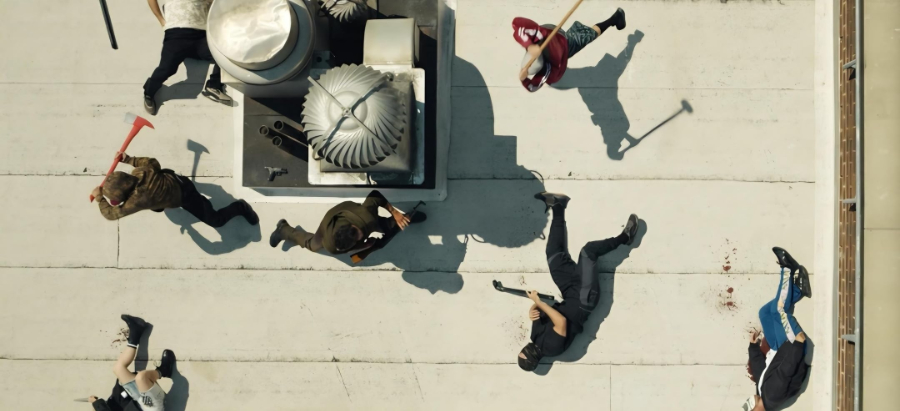
The special is strongest when it stops stumbling over explaining or justifying why Frank does what he does and simply lets him do it. These are the best “Punisher” action scenes we’ve seen yet. Bernthal won’t commit to the skull costume, but he will commit to jumping off of roofs and getting set on fire. The special is also wise to quickly establish the neighborhood people working and living around him. Characters like these help to ground extreme characters like the Punisher.
When unrelenting killers put the innocent in danger, it makes it a lot easier to feel grateful that Frank Castle, the ultimate unrelenting killer, is there to protect them. When the people bringing us Punisher productions stop rationalizing his actions and focus on the impact of his actions, it’s a lot easier to watch them.
★★★☆☆